.svg)
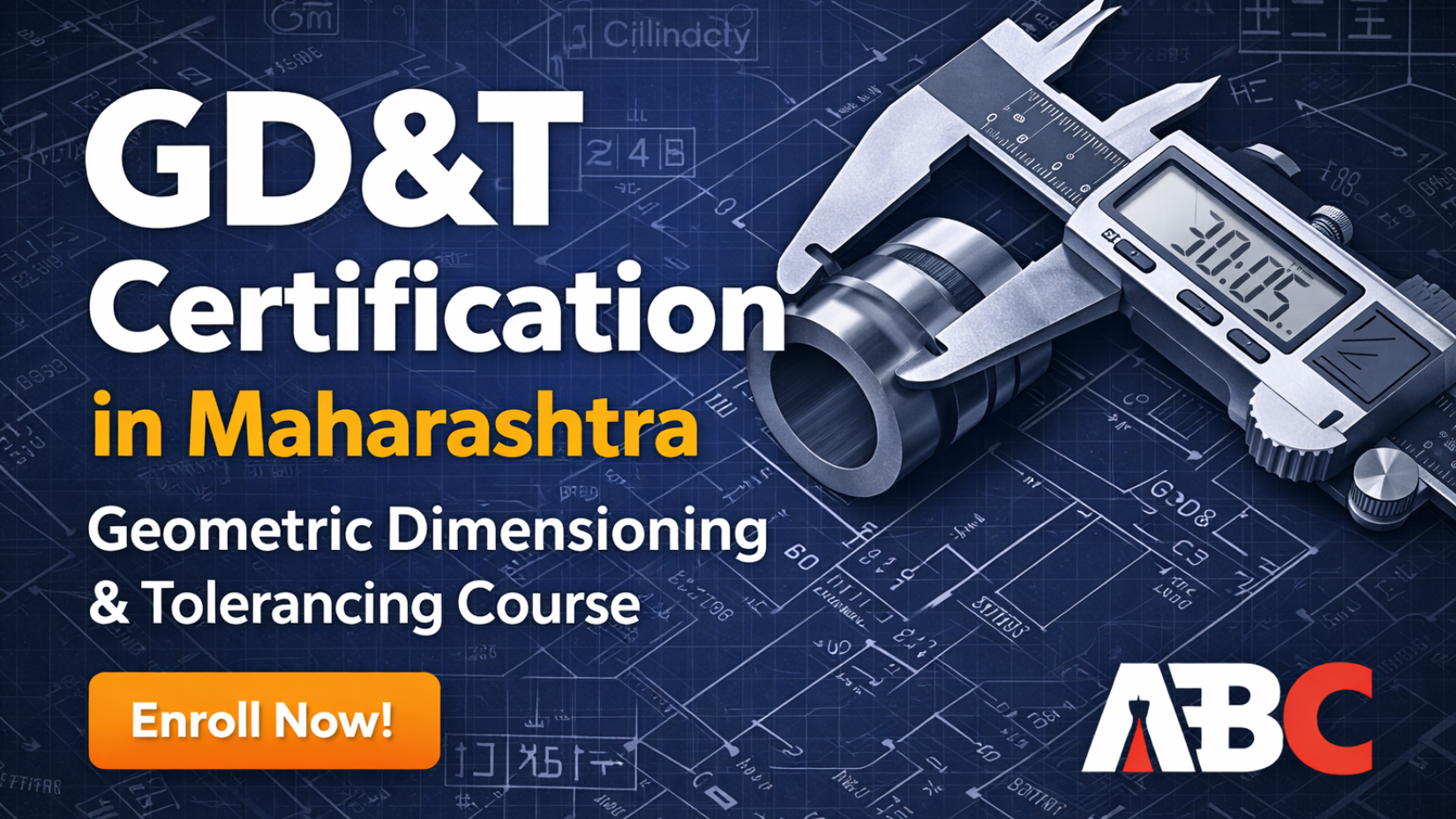
In modern manufacturing industries, engineering drawings are the foundation of production. However, traditional dimensioning methods often fail to clearly communicate functional requirements, leading to assembly issues, quality rejections, and increased manufacturing costs.
Geometric Dimensioning and Tolerancing (GD&T) solves this problem by providing a standardized and precise method to define geometry, tolerance, and functional relationships of part features.
At ABC Trainings, GD&T is taught as an industry-required skill, not just an academic topic. Our training ensures that students can read, understand, apply, and inspect GD&T exactly as expected in real manufacturing environments.
Geometric Dimensioning and Tolerancing is a standardized symbolic language used on engineering drawings to precisely define:
Size of features
Shape (form) accuracy
Orientation of features
Location of features
Relationship between mating components
The main objective of GD&T is to ensure:
Proper fit of components
Correct functional performance
Interchangeability in mass production
Unlike conventional tolerancing, GD&T eliminates ambiguity and provides clear acceptance criteria for manufacturing and inspection.
GD&T is widely used across automotive, aerospace, heavy engineering, precision manufacturing, and industrial product design because it:
Clearly defines design intent
Ensures correct fit and function of mating parts
Reduces drawing interpretation errors
Improves manufacturing flexibility
Avoids unnecessary tight tolerances
Reduces production and rework cost
Ensures interchangeability of components
Improves inspection and quality control accuracy
ABC Trainings focuses on functional GD&T, ensuring students understand why each tolerance is applied.
One of the most important industrial concepts covered in GD&T training is the direct relationship between tolerance and cost.
Tighter tolerance increases machining cost
Looser tolerance reduces manufacturing difficulty
Improper tolerance causes functional failure
GD&T helps engineers apply only the required tolerance, balancing functionality and manufacturability.
Allowance is the intentional difference between the maximum material limits of mating parts to achieve a desired fit.
ABC Trainings explains allowance in terms of:
Clearance fit
Interference fit
Clearance is the positive difference between hole size and shaft size, allowing free movement.
These concepts are critical for assemblies involving motion, rotation, or sliding.
Form tolerances control the shape of individual features:
Straightness
Flatness
Circularity (Roundness)
Cylindricity
These tolerances do not require datums because they do not depend on other features.
Orientation tolerances control feature orientation relative to a reference:
Parallelism
Perpendicularity
Angularity
Students learn how improper orientation affects assembly and function.
Location tolerances define exact feature position:
Position
Concentricity
Symmetry
ABC Trainings emphasizes functional datum selection for accurate location control.
Profile of a line
Profile of a surface
Profile tolerances are taught as advanced tools that can control form, orientation, and location together.
Circular runout
Total runout
These tolerances are critical for rotating components where vibration and wear must be controlled.
Datums (A, B, C) are theoretically perfect reference features used for measurement and inspection.
At ABC Trainings, students learn:
Datum selection based on function
Datum hierarchy
Inspection-based datum application
The course covers:
MMC (Maximum Material Condition)
LMC (Least Material Condition)
RFS (Regardless of Feature Size)
Students understand how bonus tolerance works and how it improves manufacturing flexibility.
The GD&T course strictly follows ASME Y14.5 standards:
Envelope principle
RFS default rule
Datums are theoretically exact
Material condition modifiers
Form tolerances do not require datums
Orientation tolerances require datums
Location tolerances require datums
Profile tolerances depend on datum usage
Runout tolerances require datum axis
Each rule is explained with inspection and manufacturing logic, not just definitions.
ABC Trainings follows a transparent, structured, session-wise training model:
2 hours per day training
Session-wise syllabus tracking via student login
PPT notes available for each session
Recorded expert lectures
Practical lab manuals
Mini tasks and exercises
Final project verification
Certificate auto-generated within 24 hours
Parents and students can monitor progress through the portal.
Mechanical engineering students
Diploma holders
BE / BTech graduates
Design engineers
Quality and inspection engineers
Manufacturing professionals
Working professionals upgrading skills
No prior GD&T knowledge is required.
12+ years of training excellence
Industry-oriented teaching approach
Practical drawing interpretation
Transparent student monitoring system
Verified job opportunity updates via portal
Presence across Pune, Sangli, Latur, Chh. Sambhajinagar (Aurangabad)
After successful completion of training and final project:
Certificate is generated automatically within 24 hours
Certificate is available in student login
Certification validates practical GD&T knowledge
Geometric Dimensioning and Tolerancing is not just a drawing technique, it is a manufacturing communication system. Engineers trained in GD&T perform better in design reviews, manufacturing coordination, and quality inspections.
At ABC Trainings, GD&T is taught from fundamentals to industry application, ensuring students are job-ready and confident.
Call: +91-8698270088
Website: https://abctrainings.in/explorer/
Copyright © 2026 ABCTrainings - All rights reserved