.svg)
Introduction to Automotive Embedded Systems
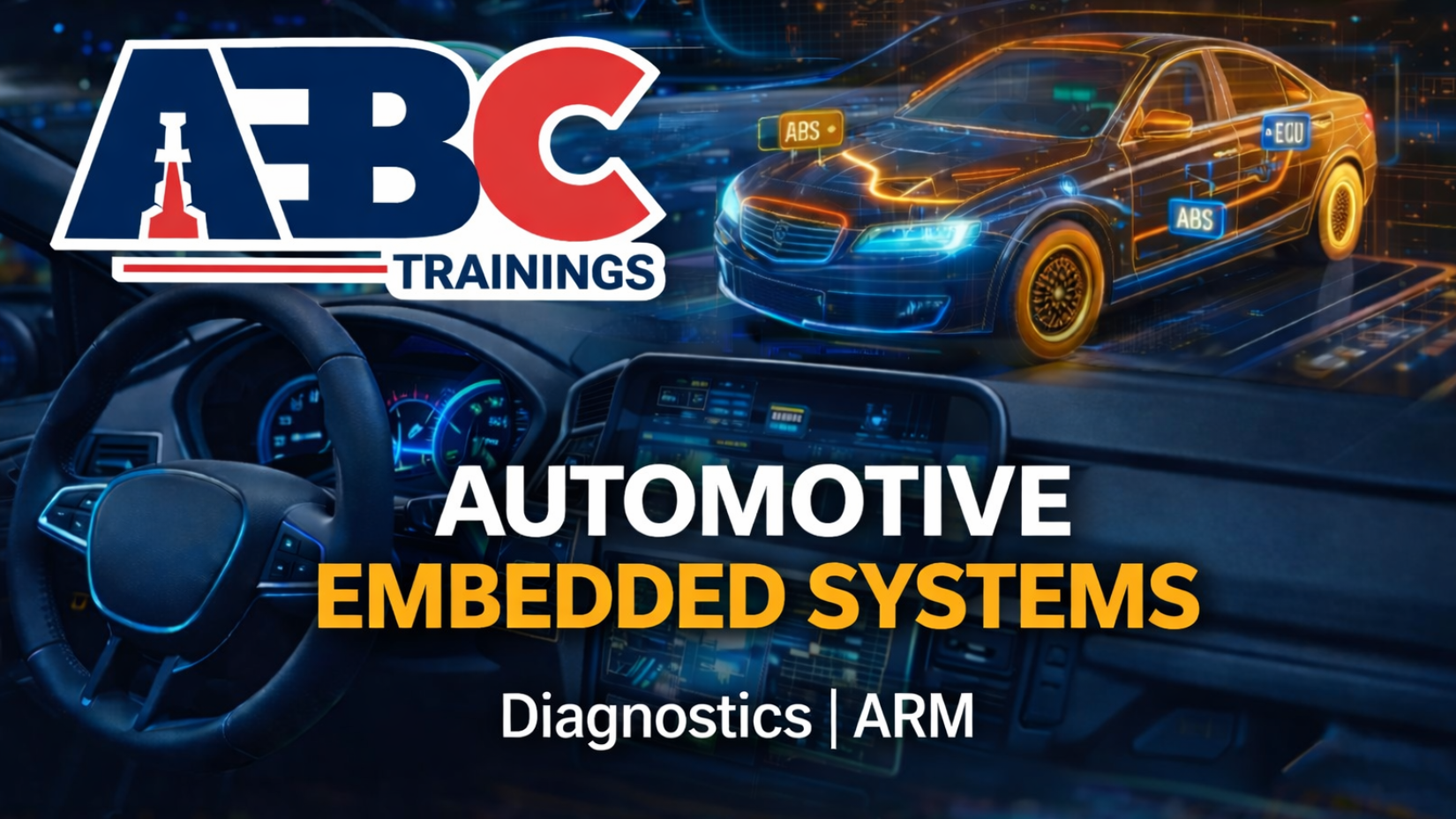
The automotive industry has entered a new era where vehicles are controlled more by software and electronics than by purely mechanical systems. Modern cars rely on intelligent computing systems to ensure safety, efficiency, performance, and comfort. These intelligent systems are known as Automotive Embedded Systems.
Automotive embedded systems are responsible for managing critical vehicle functions such as engine control, braking systems, diagnostics, safety features, and communication between electronic units. With the rapid growth of electric vehicles, connected cars, and advanced driver assistance technologies, the demand for skilled automotive embedded engineers is increasing across India.
At ABC Trainings, we provide industry-focused Automotive Embedded Systems training designed for students, graduates, and working professionals. Our training centers in Pune, Sangli, Latur, and Chh. Sambhajinagar (Aurangabad) are known for practical teaching, transparent learning systems, and strong fundamentals from scratch to advanced level.
What Are Automotive Embedded Systems?
An embedded system is a specialized computer system designed to perform a dedicated function within a larger system. In automobiles, embedded systems combine hardware components and software programs to control and monitor vehicle operations in real time.
Automotive embedded systems include:
Microcontrollers and processors
Sensors and actuators
Embedded C software
Communication protocols
Diagnostic systems
These systems are designed to work under real-time constraints, where even a small delay can affect vehicle safety or performance. That is why embedded systems require precise programming, optimized memory usage, and reliable communication.
Role of C Programming in Automotive Embedded Systems
The C programming language is the foundation of automotive embedded software development. It is widely used because it allows direct interaction with hardware while maintaining efficiency and control over memory and execution time.
In the Automotive Embedded Systems course at ABC Trainings, students learn:
C program structure
Input and output operations
Format specifiers
C tokens such as keywords and identifiers
Storage classes and variable scope
C programming plays a critical role in developing real-time applications used in automotive ECUs, control units, and diagnostic systems. A strong foundation in C enables students to understand how software controls hardware at a low level.
Variables, Data Types, and Operators in Embedded C
Variables are named memory locations whose values change during program execution. In embedded systems, understanding variables and data types is extremely important because memory resources are limited.
The course covers:
Static typing in C
Data types such as char, int, float, and double
Size and usage of each data type
Operators used for arithmetic, logical, and relational operations
This knowledge helps students write efficient and reliable code for automotive applications where performance and accuracy are critical.
Control Statements for Decision Making
Automotive embedded systems continuously make decisions based on inputs from sensors and vehicle conditions. These decisions are implemented using conditional control statements in C.
Students learn:
Simple if statements
if-else conditions
Nested if-else structures
else-if ladders
switch-case statements
Each concept is explained with practical examples so that students understand how decision-making logic works in real automotive scenarios such as braking control, engine monitoring, and fault handling.
Looping Concepts in Embedded Programming
Loops are used in embedded systems to perform repetitive tasks such as sensor monitoring, signal processing, and system checks.
The training covers:
while loop
do-while loop
for loop
Differences in condition evaluation and execution flow
Understanding looping structures is essential for designing continuous control systems used in automotive electronics.
Arrays and Memory Management in C
Arrays are linear data structures used to store collections of similar data types. In automotive embedded systems, arrays are commonly used for sensor data storage, signal buffers, and configuration tables.
The course explains:
One-dimensional arrays
Two-dimensional arrays
Multi-dimensional arrays
Memory management is also a critical topic. Students learn:
Static memory allocation
Dynamic memory allocation
Heap and stack usage
Functions such as malloc(), calloc(), realloc(), and free()
Efficient memory management ensures system stability and optimal performance in embedded applications.
Real-World Applications of Automotive Embedded Systems
Automotive embedded systems are used in several important vehicle functions:
Engine Control Unit (ECU)
Controls engine performance, fuel efficiency, and emission levels.
Anti-lock Braking System (ABS)
Prevents wheel lock-up and helps maintain vehicle control during braking.
Advanced Driver Assistance Systems (ADAS)
Supports safety features such as lane departure warnings and alerts.
Cruise Control and Airbag Systems
Improves driving comfort and passenger safety.
These applications highlight how embedded systems directly impact vehicle safety and functionality.
CAN Protocol in Automotive Communication
The Controller Area Network (CAN) protocol is a standard communication protocol used in vehicles to allow Electronic Control Units (ECUs) to communicate with each other without a central computer.
Key concepts covered include:
CAN protocol architecture
CAN node structure
Arbitration based on message IDs
CRC error detection
Reduced wiring complexity
Understanding CAN protocol is essential for anyone working in automotive embedded systems and vehicle networking.
Automotive Diagnostics: UDS and KWP Protocols
Modern vehicles rely on diagnostics to detect faults and maintain system health. Automotive diagnostic systems allow technicians and engineers to read trouble codes, monitor live data, and analyze vehicle behavior.
The course explains:
Automotive diagnostic testers
Diagnostic communication goals
UDS (Unified Diagnostic Services)
KWP (Keyword Protocol)
Students understand how diagnostic protocols are used in real-world vehicle servicing and maintenance.
ARM Microcontroller and GPIO Programming
ARM-based microcontrollers are widely used in automotive embedded applications due to their low power consumption and high performance.
The training covers:
ARM7 microprocessor architecture
RISC principles
Processor operating modes
LPC2148 microcontroller
GPIO programming using registers such as IODIR, PINSEL, and IOSET
This knowledge helps students understand how embedded software interacts directly with hardware components.
ABC Trainings Advantage for Automotive Embedded Systems
At ABC Trainings, we focus on quality training, transparency, and student success.
Our Automotive Embedded Systems training includes:
2 hours of training per day
Session-wise structured syllabus
Student login portal for syllabus tracking
PPT notes and theoretical content available in login
Expert-recorded video lectures session-wise
Industry-oriented lab manuals
Session-wise mini projects
Final project evaluation
Certificate generation within 24 hours after project completion
Verified job openings available through student login
Offline and online training options
Parents, students, and the organization can monitor progress through the portal, ensuring focused and quality training.
Who Can Join This Course?
This course is ideal for:
Engineering students and graduates
Diploma holders
Freshers looking to enter the automotive domain
Working professionals wanting to upgrade skills
Anyone interested in embedded systems and automotive electronics
No prior advanced experience is required. Training starts from basics and gradually moves to advanced automotive concepts.
Conclusion
Automotive Embedded Systems are shaping the future of the automobile industry. As vehicles become smarter and more software-driven, the demand for skilled embedded engineers continues to grow.
With strong fundamentals in C programming, communication protocols, diagnostics, and microcontroller programming, students can build a stable and long-term career in the automotive domain. ABC Trainings provides the right learning environment, practical exposure, and transparent training system to help students succeed.
If you are serious about building a career in Automotive Embedded Systems, ABC Trainings is the right place to start.
Contact ABC Trainings
📞 Call: +91-8698270088
🌐 Website: https://abctrainings.in/explorer/
Training Centers: Pune | Sangli | Latur | Chh. Sambhajinagar (Aurangabad)
Copyright © 2026 ABCTrainings - All rights reserved